
When travel dates shift, the key question is whether the existing eTA remains valid and is still linked to the passport you will present at check-in. The sections below work through the situations that matter.
What the eTA is linked to
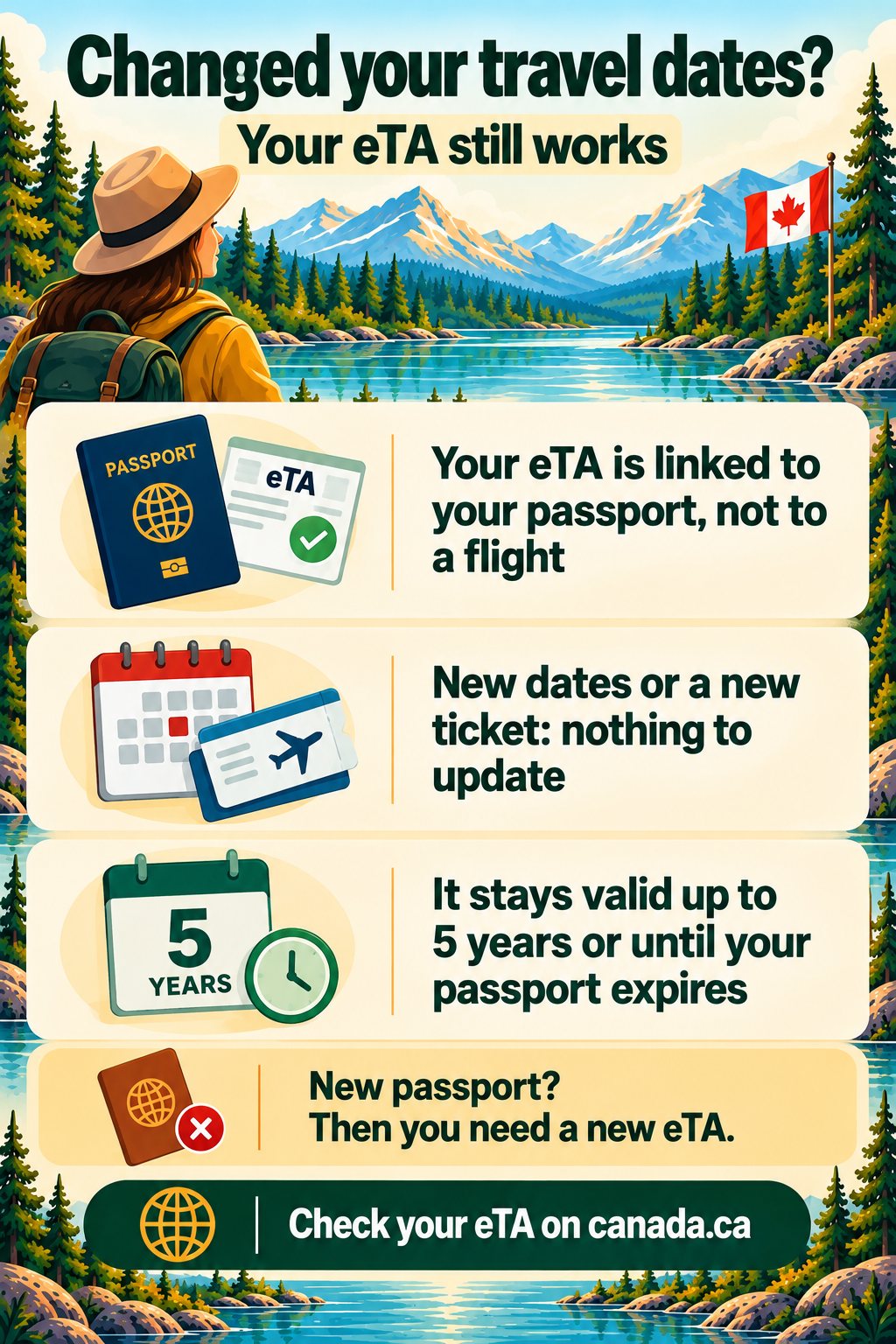
Your eTA is linked to the passport you used to apply. You need to present this passport when you check in for your flight to Canada.
Validity period
An eTA is valid for up to five years or until the linked passport expires, whichever comes first. If you get a new passport, you need to get a new eTA.
Confirming the eTA before the new travel date
The airline staff will scan your passport to confirm that you have a valid eTA. If you don’t have one, you won’t be able to board your flight.
You can check your eTA status at any point for updates on pending applications and the expiration date or status of existing eTAs.
Use the eTA Check Status tool to confirm that you have a valid eTA.
Passport number mismatch
Check that the passport number included in the eTA approval email matches exactly the number in your passport. If the passport number itself is wrong, you need to apply again with the correct number. If instead it’s the name that doesn’t match your passport, see what counts as a name mismatch on the application.
When a new eTA is required
If you get a new passport, you need to get a new eTA.
It is best to get an eTA before you book your flight to Canada.
Why the eTA Doesn’t Track Your Itinerary
It’s worth understanding why a date change doesn’t touch the eTA in the first place. The eTA record holds your passport details and your eligibility to travel to Canada by air — it does not store a flight number, a specific arrival date, or a return date. That’s why an eTA remains usable across a five-year window (or until the linked passport expires) regardless of which flights you actually book within that period. Changing your dates changes your itinerary with the airline; it does not touch the record the eTA is built from.
This also explains why the eTA supports multiple entries rather than a single fixed trip. If a delay pushes your visit back, or you decide to split one trip into two shorter visits, the same eTA generally continues to work as long as it is still valid and still tied to the passport you’re travelling with.
What Actually Forces a New Application
Given that dates alone don’t matter, it helps to be precise about the small number of things that do force a new eTA:
- A new or replacement passport. This is the most common trigger. Whether the old passport expired naturally, was renewed early, or was replaced after being lost, the eTA needs to be reissued against the new document.
- A passport number that doesn’t match the approval email. Sometimes this surfaces only when someone double-checks before a rescheduled trip — the mismatch was there from the start, it just hadn’t been noticed.
- The eTA itself expiring. If your rescheduled trip now falls after the five-year validity window, or after your current passport’s expiry date, the eTA needs to be renewed regardless of what caused the delay.
Everything else — a later flight, an earlier flight, an added stopover, a change of airline — is an airline booking change, not an immigration document change.
If Your Trip Moves by Months Rather Than Days
A short reschedule rarely raises any of the triggers above. A trip that moves by months or longer is different mainly because more time passes for something else to change in the background — a passport nearing its expiry date, for instance, or a status update you haven’t seen yet. In that situation, the practical move is the same one recommended above: check the eTA’s status and the passport’s expiry date again shortly before the new travel date, rather than assuming the original check still holds months later.
Quick reference
| Situation | Action |
|---|---|
| Flight date changed, passport unchanged | No action needed for the eTA |
| New or replacement passport issued | Apply for a new eTA |
| Passport number in approval email does not match passport | Apply again with the correct passport number |
| Rescheduled trip now falls after the eTA’s validity window | Apply for a new eTA |