
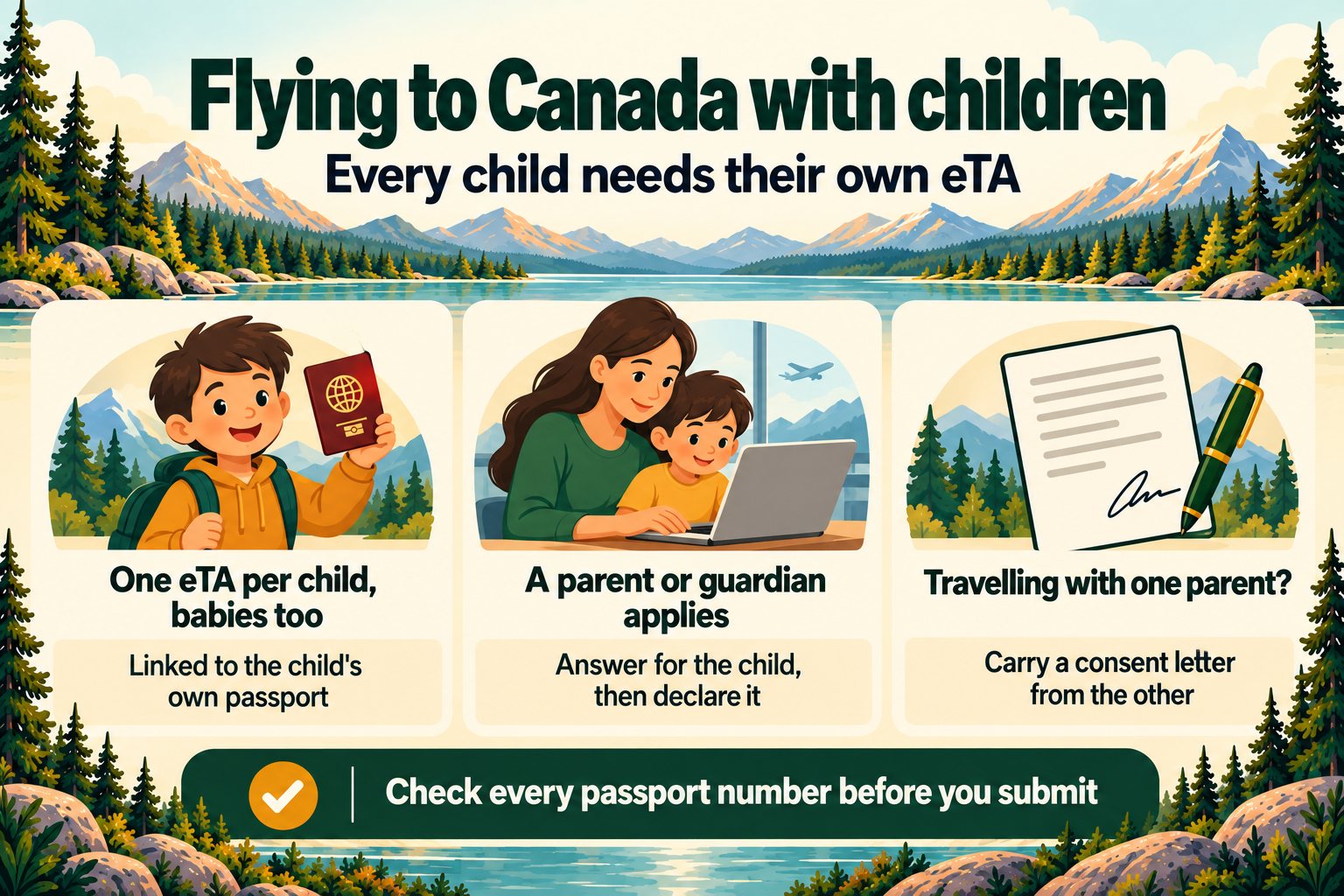
Most parents assume an eTA is one form per family, the way a single booking covers everyone on a reservation. It isn’t. Each child who flies to Canada needs their own eTA application, applied for separately, linked to their own passport. That’s the first thing to get right. The second is harder to catch: if your child’s passport renews between the application and the trip, the eTA they already have becomes useless.
Both of those problems are avoidable. The trick is knowing to look for them before you book, not the night before departure.
Does your child need an eTA?
Children under 18 are considered minors under Canadian rules, and they follow the same entry requirements as any other visitor. If your child holds a passport from an eTA-eligible country and is flying into Canada, they need an eTA. There are no exceptions for infants or young children. A two-year-old on their first passport needs one just as much as a teenager travelling to a school trip.
The eTA requirement applies to air travel. If your family is crossing into Canada by land or sea, the rules are different. For air arrivals, though, every person on the flight needs a valid eTA linked to the passport they’re carrying at check-in. Airline staff scan passports under Air Canada ID rules at the gate, and a child who doesn’t have one will not board.
If you’re unsure whether your child’s passport nationality requires an eTA or something else, the IRCC website lets you answer a few questions to confirm which document applies. That’s worth checking before you start any application, particularly for children who hold dual citizenship. The article on Canadian eTA for dual citizens: which passport to use explains the passport-choice logic in more detail, because the wrong choice here can create complications at the border.
One eTA per child: how to apply
The application itself is straightforward. You complete it online, entering the child’s passport details, contact information, and a few background questions. Most decisions arrive within minutes. Some take a few days, and the guidance is that you should expect an email within 72 hours for next steps if it isn’t immediate. Processing times can vary and are not guaranteed, so applying well before your travel date is not just sensible, it’s necessary. Last-minute applications may not come through in time.
Applying separately for each child gets easier when the form checks each passport as you type it — start your child’s eTA application when you’re ready.

For families with multiple children, you work through the same process once per child. There is no group option. Keep track of which application belongs to which passport: the approval email will include the child’s eTA number, and the passport number in that email must match the physical passport exactly. A mismatch, even a single transposed digit, can prevent travel.
One thing parents sometimes miss: you do not need to print anything. The eTA is electronically linked to the child’s passport. When you check in, the airline scans the passport and the eTA appears. What you do need to bring is the correct passport: the one the eTA was applied on. Not an older one, not a newer one.
For a full walkthrough of the application steps, the step-by-step guide to applying for a Canada eTA covers the process in detail.
The passport-renewal trap and when it matters
This is the mistake that catches families most often, and it’s almost invisible until it’s too late.
An eTA is electronically linked to the specific passport used during the application. When a child gets a new passport, that link is gone. The old eTA is still technically valid, but it’s attached to a passport the child no longer holds. At check-in, the airline scans the new passport and finds nothing. The child cannot board.
Children’s passports are often issued for shorter periods than adult passports, which means a family that applied for an eTA two or three years ago and hasn’t thought about it since may be carrying a child with a perfectly valid eTA on a passport that expired last spring. The eTA didn’t expire; the passport did. But the result is the same: a new application is needed.
The fix is simple: when a child’s passport renews, apply for a new eTA before the next trip. Don’t assume the old one transfers. It doesn’t. The article on what happens when your passport details change walks through this scenario in full, including what to do if you’ve already booked.
If you’re travelling soon and you’re not sure whether the child’s current eTA is linked to the right passport, check the eTA number in the original approval email against the passport number on the current document. If they don’t match, apply again.
Golden Rules
Every eTA is tied to one specific passport, not to the person: a new passport always means a new application.
Consent documents are a border requirement, not part of the eTA: approval of one does not substitute for the other.
A minor will not be admitted to Canada if the border officer is not satisfied that a parent or guardian has authorised the stay.
Apply early enough that a “few days” processing time does not become a missed flight.
Consent and custody documents: what the border actually checks
The eTA gets your child onto the plane. What happens at the Canadian border is a separate process, and this is where many parents are caught underprepared.
Border services officers in Canada are specifically alert to the protection of children. They check carefully for situations where a child may be travelling without proper authorisation, including cases involving parental disputes, missing children, or adults who have no legal connection to the child they’re accompanying. A valid eTA does not satisfy this check. The officer is looking at the human situation in front of them, not just the electronic record.
What you bring depends on your situation.
When you are travelling with your child and the other parent is staying home, you should carry the child’s passport, a copy of the birth certificate, and a letter of authorisation from the non-travelling parent. That letter should include the non-travelling parent’s address and phone number, and a photocopy of their signed passport or national identity card.
If you and the other parent are separated or divorced and share custody, bring copies of the custody documents and, ideally, a letter of authorisation from the other custodial parent.
If you have sole custody, your letter of authorisation covers the trip, but bring a copy of the custody decree as well.
If one parent is deceased, carry a copy of the death certificate.
If the child is travelling with a legal guardian or adoptive parent rather than a biological parent, guardianship or adoption papers are required.
Where the child is travelling with an adult who is neither a parent nor a legal guardian, that adult needs written permission from the parents or guardians, including their contact information and photocopies of their signed passports or national identity cards. Children in this situation are checked more closely.
For a child travelling entirely alone, the authorisation letter should name the adult who will be responsible for them in Canada, with that person’s address and phone number.
The consequence of arriving without these documents is not a fine or a delay while you find a fax machine. A child will not be admitted to Canada if the border officer is not satisfied that their parents or legal guardians have authorised the stay. That is the rule, stated plainly.
Your pre-travel checklist for families
Work through this before you book flights, not after.

For each child:
- Confirm the child’s passport nationality requires an eTA (not a visa)
- Check that the child’s current passport is the one the eTA is linked to
- If the passport has renewed since the last eTA was issued, apply for a new one
- Verify the passport number in the eTA approval email matches the physical passport exactly
- Apply early: most decisions are minutes, but some take several days, and last-minute applications carry real risk
For the border:
- Birth certificate (copy is fine)
- If travelling without the other parent: letter of authorisation from the absent parent, with their contact details and a copy of their signed passport
- If custody is shared after separation: copies of custody documents, plus a letter from the other custodial parent where possible
- If sole custody: custody decree
- If one parent is deceased: death certificate
- If travelling with a guardian or adoptive parent: guardianship or adoption papers
- If the child travels with a non-parent adult: written permission from both parents or guardians, with contact details and passport copies
None of these documents are part of the eTA application. They are separate, physical documents that a border officer may ask to see. Having them ready means the conversation at the border is brief.
The eTA is the easier part of this process. Get each child’s application done, check the passport numbers, and set a reminder to reapply whenever a passport renews. Everything else at the border comes down to one question the officer is always asking: has someone with legal authority over this child actually said they can be here? Your documents are how you answer that.