
You’ve heard that Canada requires biometrics for immigration applications. But for an eTA? No. Here’s what actually happens at each stage.
eTA applicants are explicitly exempt from providing biometrics. You don’t submit fingerprints. You don’t submit a photo through any biometric process. You fill in the application, pay the fee, and if it’s approved, the authorisation is linked electronically to your passport. That’s the whole thing. There is no appointment, no collection centre, no Biometric Instruction Letter. The requirement that has people worried simply doesn’t apply to this document.
What does apply, and where the confusion comes from, is worth understanding before you travel.
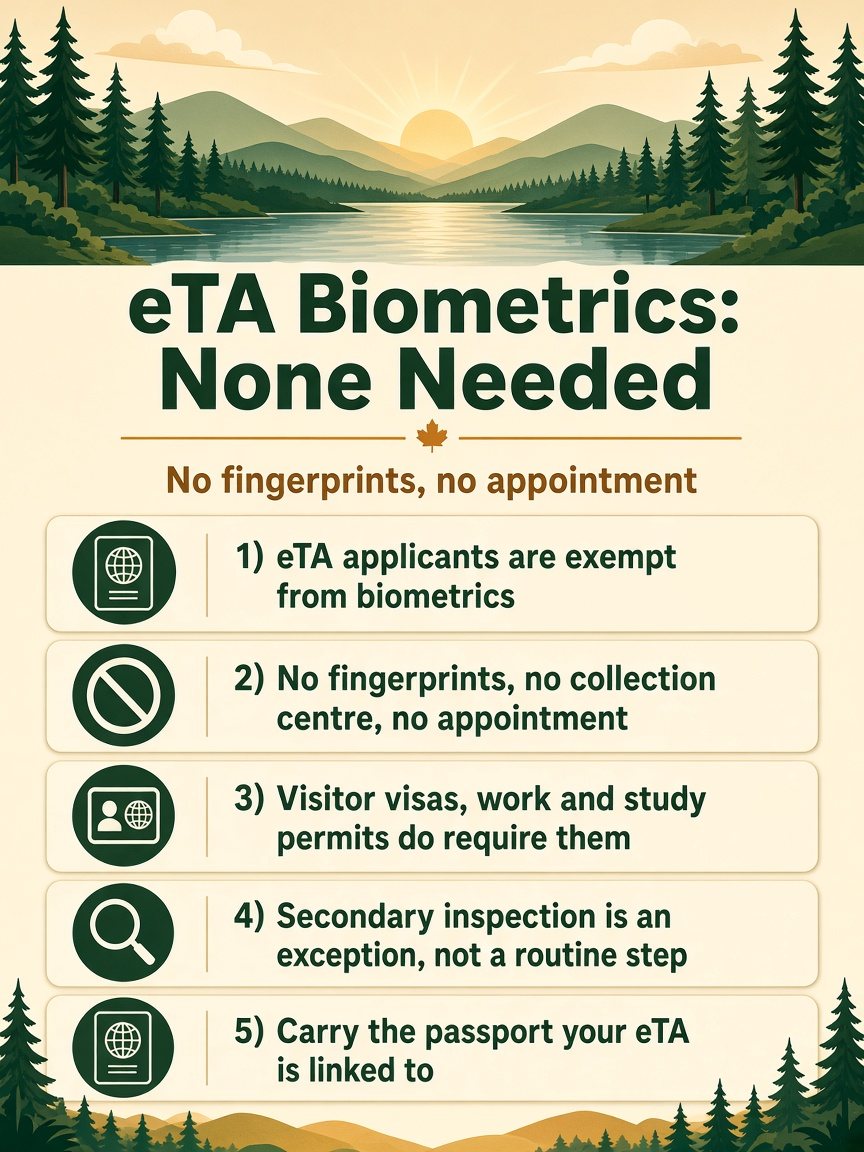
The eTA biometrics rule: what you submit, what you don’t
When Canada’s biometrics requirement came into effect, it applied to a specific category of immigration applications: visitor visas, work permits, study permits, and permanent residence applications. Visa-exempt nationals who travel on an eTA were carved out of that requirement. The rule is that if you’re coming to Canada to visit and you qualify for an eTA, you don’t provide biometrics.
This is the same reason the eTA process is relatively quick. Most decisions arrive quickly, as no part of the timeline involves booking a biometrics appointment or waiting for a collection centre slot. If you want a broader picture of what the application process actually looks like, the Canada eTA Application Checklist Before You Start covers the steps in sequence.
The eTA exemption exists because the document is designed for low-friction travel. It’s an electronic pre-screening tool, not a full immigration assessment. The trade-off is that it is not a full immigration assessment, and if you later apply for a different permit type, the biometrics rules change entirely.
Why visitor visas, work permits and study permits are different
If you were applying for a visitor visa instead of an eTA, biometrics would be required. The same applies to work permits and study permits (with an exception for US nationals). Permanent residence applications also require them, and unlike temporary residence, biometrics must be provided every time you apply for permanent residence rather than once per decade.

The process for those applicants works like this: after submitting the application and paying the biometrics fee, they receive a Biometric Instruction Letter confirming the requirement and explaining how to book a collection appointment. They then have 30 days from receiving that letter to attend. The appointment itself is free to book; the fee is for the biometrics submission. Transit visa applicants pay no biometrics fee at all.
The pattern across permit types is clearer in a table:
| Application type | Biometrics required at application stage? | Biometrics possible at the border? |
|---|---|---|
| eTA (visit only) | No | No |
| Visitor visa | Yes (in most cases) | Only if previously enrolled and being verified |
| Work permit | Yes (excluding US nationals) | Only if applying at port of entry and eligible to do so |
| Study permit | Yes (excluding US nationals) | Only if applying at port of entry and eligible to do so |
The work and study permit column is worth noting: biometrics can be given at a port of entry, but only when the applicant is eligible to apply for that permit at the border and completes the entire application there. If you’ve already submitted an application online and received a Biometric Instruction Letter, you cannot give biometrics when you arrive at the border instead.
If you’re weighing which document you actually need for your trip, the Canada eTA vs Visitor Visa: What’s the Difference piece explains the practical split clearly.
What happens at the border with an eTA
At that stage, a border officer has broader authority. If fingerprints already exist in the system from a previous visa or permit application, the Canada Border Services Agency can verify your identity against them. This isn’t something you trigger or prepare for. It’s an officer-initiated check, and it draws on data already collected during a prior application process, not from your eTA.
What secondary inspection is not: a routine step, a consequence of having an eTA, or something that happens because you failed to submit biometrics. It’s an exception, not a stage in the normal eTA arrival process. The Canada eTA Airport & Border Procedures Explained article covers what that arrival process actually looks like from the moment you land.
If you are directed to secondary inspection, the practical advice is straightforward: answer questions honestly, have your documents ready, and understand that the officer is doing a job that has nothing to do with any error on your part.
The gap between eTA and other permits — where the confusion starts
Canada’s biometrics rollout was widely covered, and the coverage rarely distinguished clearly between permit types. Articles aimed at people applying for work or study permits, or for permanent residence, described a process that simply doesn’t apply to eTA holders. Someone reading broadly about “Canada immigration biometrics” before their holiday would reasonably come away thinking they’d missed a step.
There’s also a structural reason for the confusion: the eTA sits in an unusual position. It’s an immigration document, but it’s designed to feel like almost nothing. You apply, you get approved, and the record is attached to your passport electronically. There’s no stamp, no physical card, no appointment. That invisibility makes it easy to assume something must be missing.
One edge case worth knowing: if you previously held a visitor visa, work permit, or study permit for Canada and gave biometrics at that time, those records exist in the CBSA system. Travelling later on an eTA doesn’t erase them. The officer at the border can still verify your identity against stored biometrics if they choose to. This isn’t a problem — it’s just how the identity verification infrastructure works across document types. Your eTA application itself required nothing from you biometrically, but your history with Canadian immigration is cumulative.
Age exemptions exist within the biometrics system for those permits that do require them: children under 14 and applicants over 79 are exempt from providing biometrics. These exemptions are irrelevant to eTA applicants, since the exemption from biometrics already applies to everyone in that category regardless of age.
What you need to do before your trip (spoiler: nothing biometric)
Your eTA checklist has no biometrics line. There’s no appointment to book, no collection centre to visit, no letter to wait for. Once your eTA is approved and linked to your passport, you’re done with the document side of things. Carry the passport it’s linked to when you travel — that’s the only physical requirement.
If you haven’t applied yet, starting your eTA application now leaves time to fix any small errors before your flight, since there’s no biometrics appointment to wait for.
If you want to confirm your eTA is still active before you fly, the official status check at IRCC’s eTA status page takes a few minutes and requires your passport details together with the application number or UCI from your confirmation email.
The one thing that changes the picture entirely is if you later apply for a different type of permit — a work permit to take a job, a study permit for a programme, or a visitor visa because your circumstances shift. At that point you’d leave the eTA category and enter a process where biometrics are almost certainly required. But that’s a different application, a different document, and a different set of rules.
The Bottom Line
The biometrics requirement is real, consequential, and genuinely demanding for the people it applies to — but eTA applicants are not those people. You haven’t missed a step, there’s no appointment you should have booked, and nothing about the border process requires you to have submitted fingerprints in advance. The one moment fingerprints might enter the picture is if a border officer verifies your identity against records from a prior visa or permit application, which is officer-initiated and not something you can or should prepare for differently because of it.