
Many Global Entry members assume their U.S. trusted-traveller status carries weight in Canada. It doesn’t. You can hold a valid Global Entry card, have sailed through U.S. Customs and Border Protection kiosks for years, and still be turned away at the airline check-in desk for a flight to Toronto if you haven’t sorted out Canada’s own entry requirement first. The answer to the core question is this: Global Entry membership does not exempt you from Canada’s eTA, does not speed up the application, and is not visible to Canadian immigration systems in any way that helps you. If you’re unsure whether you need an eTA or a visa, the Canada eTA vs. visitor visa differences article explains how to tell them apart. American citizens with Global Entry can read do US citizens need a Canada eTA.
That’s the whole myth, dismantled. The rest of this piece shows you why it works that way, what each system is actually doing, and what the non-negotiable rule looks like in practice.
The mistake: why Global Entry doesn’t work for Canada
The confusion is understandable. Global Entry feels like a signal that you’ve been vetted — fingerprinted, interviewed, background-checked by a federal agency. If the U.S. government trusts you, why wouldn’t Canada?
Because Canada didn’t do the vetting. That’s the entire reason. Global Entry is a programme run by U.S. Customs and Border Protection. Its purpose is to speed up your re-entry into the United States. When you land at a U.S. airport, you use the kiosk, skip the officer queue, and you’re done. That’s what you paid for. The programme was never designed to say anything to any other country’s border authority, and it doesn’t.
Canada runs its own entry systems under its own federal institutions — Immigration, Refugees and Citizenship Canada (IRCC) handles authorisation, and Transport Canada governs what happens at the airport. Neither of those bodies has a data-sharing arrangement with Global Entry that would translate your U.S. trusted-traveller status into a Canadian entry permission. You are, from Canada’s perspective, a traveller arriving with a passport. What matters is what’s linked to that passport.
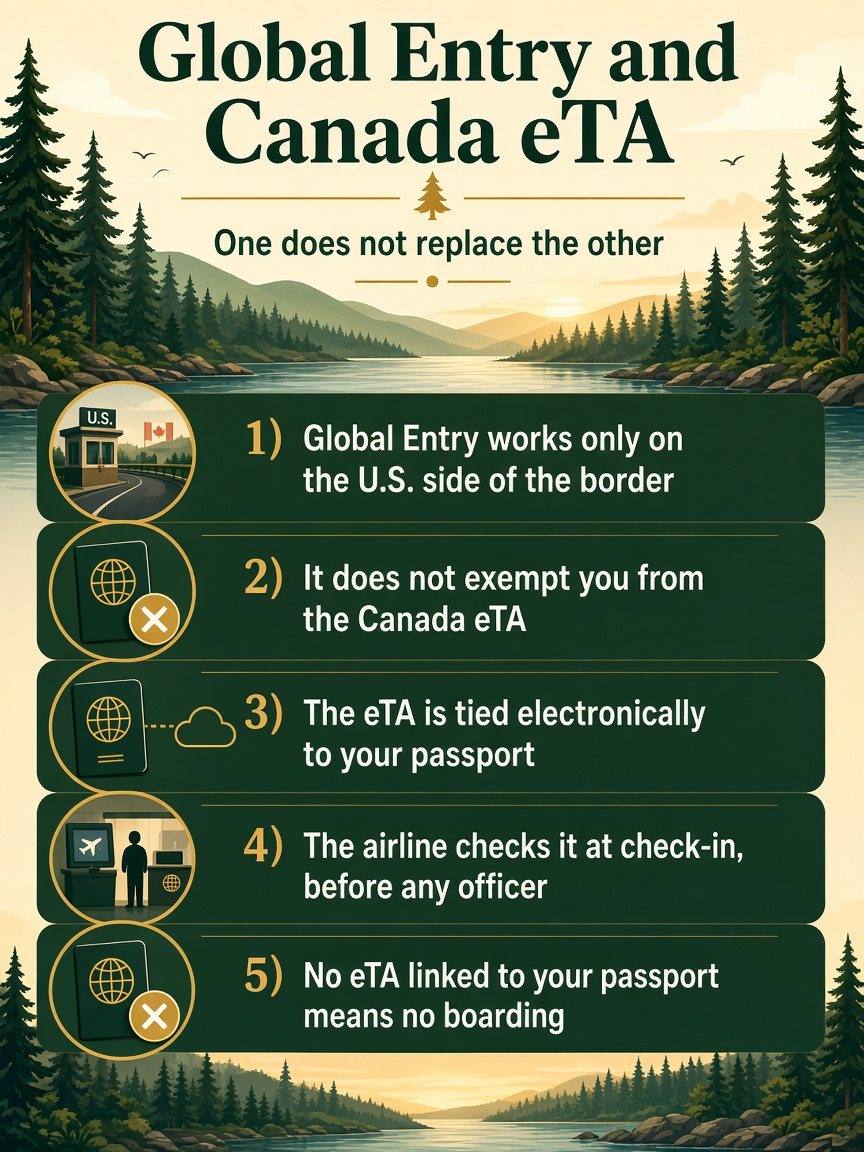
What Global Entry actually covers
Global Entry gives you expedited clearance at participating U.S. airports when you return from international travel. You scan your passport, press your fingers to the reader, answer the customs declaration questions on screen, and collect your receipt. No line, no officer, usually under two minutes.
That’s the scope of it. It works on the U.S. side of the border, at the moment of re-entry. It doesn’t cover departures from the U.S., and it doesn’t cover entry into any other country. Some airlines and airport lounges treat Global Entry membership as a proxy for TSA PreCheck, which can make the outbound security experience smoother — but that’s a domestic U.S. benefit, and it ends at the gate.
The moment your flight crosses into Canadian airspace, Global Entry has done everything it will ever do for that trip.
What Canada’s eTA actually is
An eTA — electronic travel authorization — is a pre-travel permission that Canada requires from visa-exempt foreign nationals arriving by air. It’s tied electronically to your passport. When an airline scans your passport at check-in, their system confirms whether a valid eTA is linked to it. If there isn’t one, you don’t board. The check happens before you reach any Canadian border officer.
Global Entry doesn’t replace the eTA: if you’re not a US citizen or permanent resident and hold a visa-exempt passport, you still need to apply for an eTA.
 Photo by Rob Swystun from Winnipeg, Canada on wikimedia (CC BY 2.0)
It’s worth understanding what an eTA is not. It isn’t a visa. It doesn’t guarantee entry — a border officer can still refuse you on arrival. It’s an authorisation to board a flight to Canada, issued after a background check against Canadian databases. Decisions are often quick, but some applications may require additional review.
Check the official IRCC page for current validity details. If you travel to Canada regularly, you apply once and it sits quietly linked to your passport for years.
If you’re comparing this to the U.S. system, the Canada eTA vs. U.S. ESTA differences piece on this site lays out where the two programmes genuinely overlap and where they part ways.
Why the two systems don’t overlap
Global Entry and Canada’s eTA are solving different problems for different governments. They don’t overlap because they were never meant to.
Global Entry is about exit processing from the perspective of a returning U.S. resident. It asks: has this person already been cleared to live in or visit the U.S., and can we move them through re-entry faster? The vetting is about your U.S. immigration status and your customs declaration history.
Canada’s eTA is about entry authorisation from the perspective of a Canadian border authority. It asks: is this person admissible to Canada under Canadian law, and do they have any flags in Canadian or partner databases? The vetting is entirely separate, run against different records.
There’s no mechanism — not a treaty, not a data link, not a reciprocal agreement — that lets a U.S. trusted-traveller clearance substitute for a Canadian entry authorisation. Two governments, two systems, two separate decisions. Your Global Entry approval doesn’t appear in IRCC’s records. IRCC’s eTA decision doesn’t appear in CBP’s records. They simply don’t speak to each other in this way.
Pro Tips
Apply with the passport you’ll travel on, not your most recently renewed one. The eTA is tied to a specific passport number. If you renewed your passport after getting your eTA, the old authorisation is useless at check-in — the airline system won’t see it. Check what happens when your passport details change after an eTA is issued before you assume you’re covered.
Don’t apply the night before departure. Most eTAs come back in minutes, but some go into extended review that takes days. There’s no way to know in advance which yours will be. Applying a week out costs you nothing and removes the one scenario that actually strands people.
If you are a U.S. green card holder, your entry requirements may differ. Consult the official IRCC tool to determine if you need an eTA or a visa. The Canada eTA rules for U.S. green card holders covers the specific conditions.
An eTA doesn’t cover transiting Canada by air if you’re continuing to a third country. That’s a separate authorisation requirement. If your routing takes you through a Canadian airport on the way somewhere else, check the transit rules before you assume your eTA handles it.
The one rule that never changes
Canada controls who boards flights to Canada. That control is exercised through the eTA system, and it operates independently of anything the U.S. government has decided about you. It doesn’t matter how long you’ve held Global Entry, how many times you’ve cleared U.S. customs without incident, or how clean your travel history is. If your passport doesn’t have a valid Canadian eTA linked to it, the airline cannot let you board.

That rule applies at every participating airport, on every airline flying to Canada, every time. There are no exceptions for trusted-traveller programme members, no grace periods, no workarounds at the gate. The check is automated and it runs before a human ever looks at your documents. By the time you’re standing at a check-in desk, the window for fixing a missing eTA has already closed.