
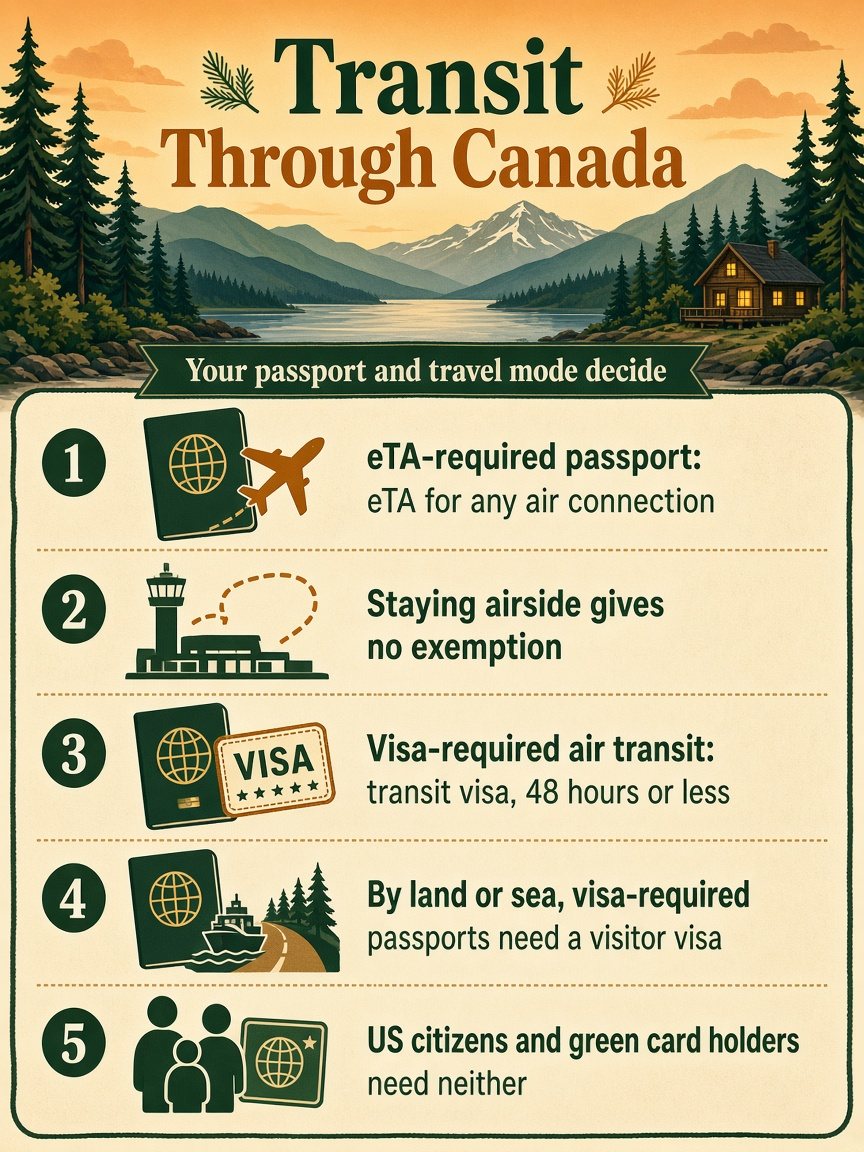
Short version: yes, if your passport is from an eTA-required country you need an eTA for any connection through a Canadian airport, even if you never leave the international area. Visa-required passports need a transit visa (48 hours or less) instead, unless they qualify for an eTA under the conditional rules, and U.S. citizens and U.S. green card holders need neither. You can apply for an eTA through a paid private service, separate from the Government of Canada.
Many transiting passengers believe a short layover or airside connection exempts them from Canada’s eTA requirement. It does not. Your document requirement depends on factors such as your passport country, how you travel through Canada (by air, car, bus, train, boat, including cruise ship), how long your transit will take, and other factors like being a permanent resident of the United States or a US visa holder.
Those three factors are not formalities. They produce genuinely different answers. A German passport holder connecting through Toronto on two international flights needs an eTA. The same German passport holder crossing into Canada by train does not. A Moroccan passport holder doing the same Toronto connection needs a transit visa unless they qualify for an eTA under the conditional rules (Morocco is on that list: you must have held a Canadian visitor visa in the past 10 years or hold a valid U.S. non-immigrant visa). And a U.S. citizen doing either trip needs neither. The table below shows every case at once.
The Three Factors That Determine Your Transit Document
Your passport country is the starting point. Canada divides the world into three groups: countries whose citizens need a visitor visa to enter Canada at all, countries whose citizens need an eTA when travelling by air, and the United States. Where you fall in that division determines what the next two factors mean for you.
How you enter Canada is the second split. Air entry and land-or-sea entry follow different rules, not because the border is different, but because the eTA system only applies to air travel. If you arrive by train, bus, boat, or cruise ship, the eTA question disappears entirely, and what you need depends solely on your passport country.
What you do in Canada matters most for visa-required passport holders. If you only change between international flights and stay within 48 hours, a transit visa applies; if you enter Canada or stay longer than 48 hours, you need a full visitor visa. For eTA-required passport holders, it makes no difference: you need the eTA regardless. For U.S. citizens and lawful permanent residents, it makes no difference either: they can transit by any mode without a visa.
Air Transit: eTA or Visa?
| Passport Country | Air Transit | Result |
|---|---|---|
| eTA-required country | Connecting between international flights | eTA required |
| eTA-required country | Arriving and leaving the airport | eTA required |
| Visa-required country | Flight stop or connection between international flights, 48 hours or less, no visitor visa | Transit visa required |
| Visa-required country | Staying in Canada >48 hours, or visiting Canada during the layover | Visitor visa required |
| Conditional eTA country (for example Morocco, Brazil or Mexico) that have held a Canadian visitor visa in the past 10 years or hold a valid U.S. non-immigrant visa | Air transit | eTA instead of a transit visa |
| U.S. citizen | Any air transit | No eTA or visa needed |
| U.S. lawful permanent resident | Any air transit | No eTA or visa needed |
| China, Indonesia, Philippines, Thailand, Taiwan (no personal ID number) | Air transit on the way to or from the United States | May qualify for transit without a visa, check conditions |
A few notes that the table can’t fully capture. The first row covers every eTA-required passport, however far the trip: a New Zealand passport holder connecting in Vancouver needs an eTA just like a German one. If you already hold a valid visitor visa, you can use it for your transit until it expires. You don’t need to obtain an eTA separately. Citizens of Indonesia and Malaysia who meet certain requirements may now be eligible for an eTA rather than a visitor visa, following a change that took effect May 26, 2026; if you hold either of those passports, verify your current eligibility on the official Canadian immigration transit page before applying for anything.
Trusted-traveller cards don’t change any of this either. Global Entry and Canada’s eTA explained side by side shows why a US trusted-traveller card has no bearing on Canada’s own requirement, even for a connecting flight.
The transit visa conditions are specific: your international flight stops at a Canadian airport on its way to another country, you’re connecting between two international flights at one or more Canadian airports, your transit lasts 48 hours or less, you don’t hold a valid visitor visa, and you’re not eligible for an eTA. All of those must be true simultaneously. If your transit runs longer than 48 hours, or if you plan to visit Canada during the layover (even for a few hours), you need a full visitor visa instead.
For eTA-required passport holders, the difference between an eTA and a visitor visa is worth understanding before you apply, since the two documents involve different processes and eligibility criteria.
Land or Sea Transit: eTA or Visa?
If you’re entering Canada by train, bus, car, boat, or cruise ship, even briefly, even just to cross from one U.S. state to another through a strip of Canadian territory, the eTA rule does not apply. What you need instead depends on your passport country in a simpler way.
U.S. citizens and lawful permanent residents of the U.S. can transit by any of these modes without a visa, provided they carry the right travel documents. If you’re a U.S. green card holder, the entry procedures for U.S. permanent residents explain what documents to carry.
Passport holders from visa-required countries who enter Canada by bus, car, train, boat, or cruise ship need a visitor visa, not a transit visa. The transit visa category only applies to air travel. This catches people off guard: if your route involves a ferry or a train crossing into Canada, the shorter transit visa pathway is not available to you.
eTA-required passport holders crossing by land or sea do not need an eTA for that crossing, and the same goes for a cruise (see eTA rules for cruise and ferry passengers). They do need to carry valid travel documents, typically their passport and, depending on their destination, whatever documentation the country they’re heading to requires.
The Airside Connection Myth
The belief that staying airside (never leaving the secure international zone) removes the document requirement is widespread and wrong for every passport holder who needs a document to fly through Canada.
Holders of eTA-required passports are subject to the requirement the moment they board a flight bound for a Canadian airport. The airline checks it at check-in, before you ever reach Canada. Whether you walk through the terminal to a connecting gate or sit in a single seat for four hours, the eTA was required when you checked in at your origin airport. There is no airside exemption for this group.
The confusion likely comes from other countries’ transit rules, where airside status genuinely changes what documents are required. Canada’s eTA rule doesn’t work that way. The trigger is the flight to Canada, not the act of clearing Canadian customs.
For visa-required passport holders, a document is always required. What makes a transit visa available instead of a full visitor visa is not “airside status” but the fact that you are only changing between international flights and stay within 48 hours, without visiting Canada. It doesn’t remove the document requirement; it changes which document you need. You still need something before you board.
The practical consequence: if you discover at check-in that you’re missing an eTA or transit visa, your airline will not board you. Fixing this at the departure gate is not realistic. Most eTA decisions arrive within minutes, some take several days, and a transit visa application takes longer than that. The time to sort this out is before you leave for the airport.
If You’re Rebooked Through Canada
Flight disruptions and schedule changes sometimes route passengers through Canada who never planned to transit there. The document requirement doesn’t change because the rerouting was involuntary: you still need the correct document before boarding the Canada-bound flight.

If you’re rebooked at a connecting airport in a third country and the new routing goes through Canada, ask the airline immediately whether you hold the right documentation. If you don’t, the airline should work with you on alternatives, because boarding you without the required document creates a problem for the carrier as well. This is not a situation where you can sort things out on arrival.
One edge case worth knowing: if you already hold a valid visitor visa for Canada, it covers your transit regardless of how the routing came about. You don’t need an eTA in addition to a valid visa.
An eTA is tied to the passport it was issued for. If your passport changes, the eTA linked to the old passport does not transfer, so check what happens when your passport details change before you travel.
The Short Version
- If your passport is from an eTA-required country, the eTA applies to any air transit through Canada, regardless of connection time or whether you leave the airport.
- Visa-required passport holders transiting by land or sea need a visitor visa, not a transit visa. The transit visa applies to air travel only.
- Visa-required passport holders from a conditional eTA country (Morocco, for example) can use an eTA instead if they meet the conditions.
- Whatever the mode, U.S. citizens and U.S. lawful permanent residents can cross into Canada without a visa, provided they carry valid travel documents.
FAQ
Do I need a Canadian eTA for a connecting flight? Yes, if your passport is from an eTA-required country. The eTA applies to any air transit through a Canadian airport, however short the connection.
Does Canada require a transit visa for a layover? Only for visa-required passports: a transit visa applies if you only change between international flights and stay 48 hours or less. Some visa-required passports qualify for an eTA instead under the conditional rules.
Do I need an eTA if I stay airside in Toronto or Vancouver? Yes, if your passport is from an eTA-required country. Staying airside does not remove the requirement, because the airline checks it when you board the flight bound for Canada.
Do U.S. green card holders need an eTA to transit Canada? No. U.S. citizens and lawful permanent residents of the U.S. need neither an eTA nor a visa to transit, provided they carry valid travel documents.